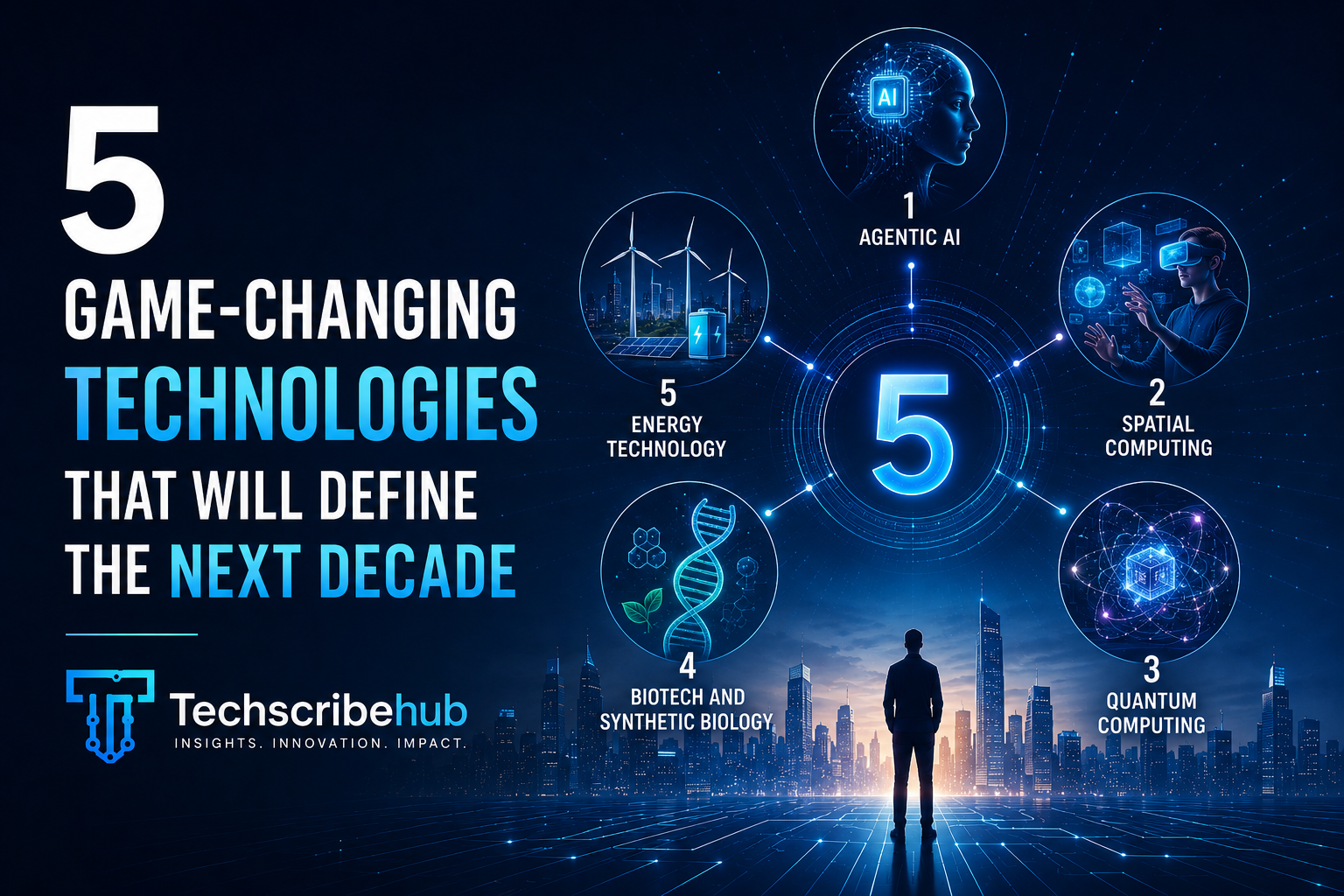
5 Game-Changing Technologies That Will Define the Next Decade
2026-06-22 · Engineering · 8 min read · @TechScribeWire
The future isn’t coming. It’s already compiling in the background — and most people haven’t noticed.
There’s a particular kind of vertigo that sets in when you realise a technology has quietly crossed from “experimental” to “inevitable” – and you missed the moment it happened.
It happened with smartphones. It happened with cloud computing. It happened with social media. And right now, in 2026, it’s happening again – simultaneously, across five distinct technological frontiers – and most professionals are still treating these shifts like talking points rather than tectonic forces.
This isn’t a list of buzzwords. Every technology on this list is already generating real revenue, reshaping real industries, and demanding real strategic responses from the companies paying attention. The question isn’t whether these technologies will define the next decade. It’s whether you’ll be a participant in that transformation or a spectator of it.
Let’s get into it.
- Agentic AI: The Shift from Chatbots to Autonomous Operators We spent the first half of the 2020s marvelling at AI that could answer questions. We’re about to spend the second half grappling with AI that can complete projects.
The distinction matters more than it sounds.
Agentic AI systems — models that can plan multi-step workflows, use tools, browse the web, write and execute code, and course-correct based on results — represent a categorical leap beyond the chatbot paradigm. When you ask a chatbot something, it responds. When you deploy an agent, it acts.
Early enterprise deployments are already telling. Coding agents are now handling full feature implementations, not just autocomplete. Research agents are compressing weeks of competitive analysis into hours. Customer service agents are resolving complex multi-system issues without human escalation. The productivity differential between companies that have internalized agentic workflows and those still treating AI as a “helper tool” is starting to become measurable — and it’s significant.
But here’s what most technology commentary misses: the real disruption isn’t labour replacement. It’s organisational redesign. The companies winning with agentic AI aren’t the ones asking, "Which jobs can we cut?” They’re the ones asking, "What becomes possible that was never possible before?” — and then rebuilding their operations around that answer.
The next decade will belong, in large part, to whoever figures out how to manage, audit, and strategically deploy AI agents at scale. That’s not a technical problem. It’s a leadership and systems problem. And very few organisations are treating it as such.
- Spatial Computing: The Interface Revolution Nobody Is Talking About Seriously The failure of early VR wasn’t a technology failure. It was an imagination failure. We built virtual reality and filled it with… the same flat screens we were already staring at. We recreated the desktop metaphor in 3D space and called it innovation.
Spatial computing — the convergence of AR, VR, mixed reality, and increasingly, AI-driven spatial understanding — is something fundamentally different. And the hardware is finally catching up to the concept.
The thesis is simple but radical: the computer monitor is an artifact of a specific hardware era, not a natural law. When display technology becomes lightweight, high-resolution, and contextually aware enough to overlay seamlessly with the physical world, the constraint of a screen boundary dissolves. Information becomes spatial. Interfaces become environmental. Collaboration becomes presence.
We’re not fully there yet. But the trajectory is unmistakable. Enterprise adoption in architecture, surgical planning, remote maintenance, and immersive training is accelerating. The industrial use cases are being refined into genuine operational advantages — reduced error rates, faster onboarding, and richer institutional knowledge transfer.
The consumer moment is still maturing. But consumer moments follow enterprise maturation, not the other way around. The professionals who understand spatial computing now — not as a gaming curiosity but as a new paradigm for human-computer interaction — will have a decisive advantage as the hardware crosses its mainstream threshold.
The interface revolution is coming. It won’t look like anything we called “the metaverse".
- Quantum Computing: Still Nascent, Already Irreversible Press enter or click to view image in full size
Photo by Growtika on Unsplash It would be dishonest to claim quantum computing is ready to disrupt your industry next quarter. It’s not. But it would be equally dishonest — and strategically dangerous — to dismiss it as distant science fiction.
The honest picture in 2026 is this: quantum systems are now solving specific, narrow problems faster than any classical computer can. Molecular simulation for drug discovery. Optimisation problems in logistics and financial modelling. Cryptographic analysis at scales that previously weren’t feasible. These aren’t toy demonstrations. They’re commercially contracted proof-of-value deployments, happening now, in high-stakes industries.
The reason quantum matters for the next decade isn’t that it will replace classical computing. It won’t. It’s that quantum will become the tool of choice for a specific category of problems – those involving enormous combinatorial complexity – and those problems happen to sit at the heart of pharmaceutical R&D, materials science, supply chain optimisation, and cybersecurity.
The cybersecurity angle deserves particular attention. “Harvest now, decrypt later” attacks — where encrypted data is captured today with the intention of decrypting it when quantum capability matures — are already a documented threat vector. Organisations handling sensitive long-horizon data (medical records, national security information, and intellectual property) need to be thinking about quantum-safe encryption now, not when quantum computers are mainstream.
Quantum computing rewards preparation, not reaction. The next decade will bifurcate industries into those who built quantum literacy early and those who scrambled to catch up.
- Biotech and Synthetic Biology: The Programmable Physical World Every technology on this list involves information. But synthetic biology is doing something different: it’s turning biology itself into an information technology.
CRISPR gene editing has moved from laboratory phenomenon to clinical reality. The first CRISPR-based therapies for sickle cell disease were approved in late 2023 and early 2024. That was a threshold moment — the transition from "Can we do this?” to "We are doing this, in humans, with regulatory sanction.” The pipeline behind those first approvals is deep, diverse, and accelerating.
But the implications extend far beyond medicine. Synthetic biology is beginning to reshape agriculture (crops engineered for drought resistance and nitrogen efficiency), materials science (biofabricated textiles and construction materials grown rather than manufactured), environmental remediation (organisms engineered to break down microplastics and sequester carbon), and industrial manufacturing (biological processes replacing petrochemical ones in everything from cosmetics to fuel).
The convergence of AI and biotech is particularly powerful. Protein structure prediction models — which represent one of the most significant scientific breakthroughs of the past decade — have collapsed the timeline for drug discovery and enzyme engineering from years to months. We are building computational tools that dramatically accelerate our ability to design life.
This creates extraordinary possibilities and equally extraordinary ethical terrain. The next decade will force urgent, society-level conversations about access, ownership, dual-use risks, and the governance of technologies that operate at the intersection of code and DNA. Those conversations need people who understand both the science and the stakes.
- Energy Technology: The Infrastructure Layer for Everything Else Every technology on this list is power-hungry. Agentic AI systems running at scale require massive computational infrastructure. Spatial computing demands always-on local processing. Quantum systems require near-absolute-zero operating environments. Biotech labs run energy-intensive workflows around the clock.
This makes the trajectory of energy technology – battery storage, next-generation solar, advanced nuclear, and grid intelligence – not just an environmental story or a policy story. It’s the foundational infrastructure story for the entire tech landscape.
The economics of renewable energy have already crossed their most important threshold: solar and wind are now the cheapest sources of new electricity generation in most of the world. But cheapness and reliability are different problems. The next decade is about solving the reliability challenge — building the storage, grid flexibility, and demand response systems that turn intermittent generation into consistent baseload power.
The breakthrough that may define this decade isn’t a single technology. It’s the intelligent integration of a dozen technologies — grid-scale batteries, demand forecasting AI, distributed energy resources, smart building systems, and eventually, potentially, practical fusion power — into an energy system that is simultaneously cleaner, cheaper, and more resilient than what we’ve built over the past 150 years.
For technology professionals, the energy transition isn’t background noise. It’s the infrastructure layer that either enables or constrains everything else we want to build. Understanding it — even at a non-specialist level — is rapidly becoming a core component of strategic literacy.
The Meta-Pattern Across All Five Press enter or click to view image in full size
Photo by Umberto on Unsplash Reading across these five technologies, a pattern emerges that I think is more important than any individual technology on the list.
Every one of these shifts is a convergence story. Agentic AI is more powerful when it understands biology, when it can reason about spatial environments, and when it’s backed by quantum optimisation. Energy technology shapes where AI infrastructure can be built and at what scale. Biotech accelerates when AI handles protein folding and quantum computing handles molecular simulation.
The professionals who will define the next decade aren’t specialists who master one of these domains in isolation. They’re people with sufficient literacy across several of them to see the intersections – to recognise, before it’s obvious, that two apparently separate technological trajectories are about to collide and create something neither field anticipated alone.
That cross-domain fluency is the actual competitive advantage. And it’s rarer than technical depth.
What This Means for You, Right Now Strategy without action is just anxiety with better vocabulary. So here’s the practical implication:
You don’t need to become an expert in quantum mechanics, CRISPR biology, and power grid engineering simultaneously. What you need is sufficient literacy to participate in conversations, evaluate claims, ask the right questions, and recognise when a development in one of these spaces has material implications for your industry.
That means building a deliberate information diet. It means following the right researchers, analysts, and practitioners — not just the technology press, which has a well-documented tendency to confuse hype with signal. It means engaging with primary sources: academic preprints, investor memos, regulatory filings, and the genuine work of people building these technologies, not just commentating on them.
The next decade will be defined by these technologies. The question of whether you’re an informed participant in that decade or a confused spectator of it is a question you can answer starting today.
If this kind of analysis is useful to you, consider subscribing to weekly breakdowns of emerging technology signals — no hype, no buzzword bingo, just clear-eyed analysis of what’s actually happening and why it matters. The best technology intelligence isn’t about predicting the future. It’s about understanding the present with enough precision that the future becomes legible.
→ Subscribe for weekly updates and join thousands of tech professionals who refuse to be caught off guard.