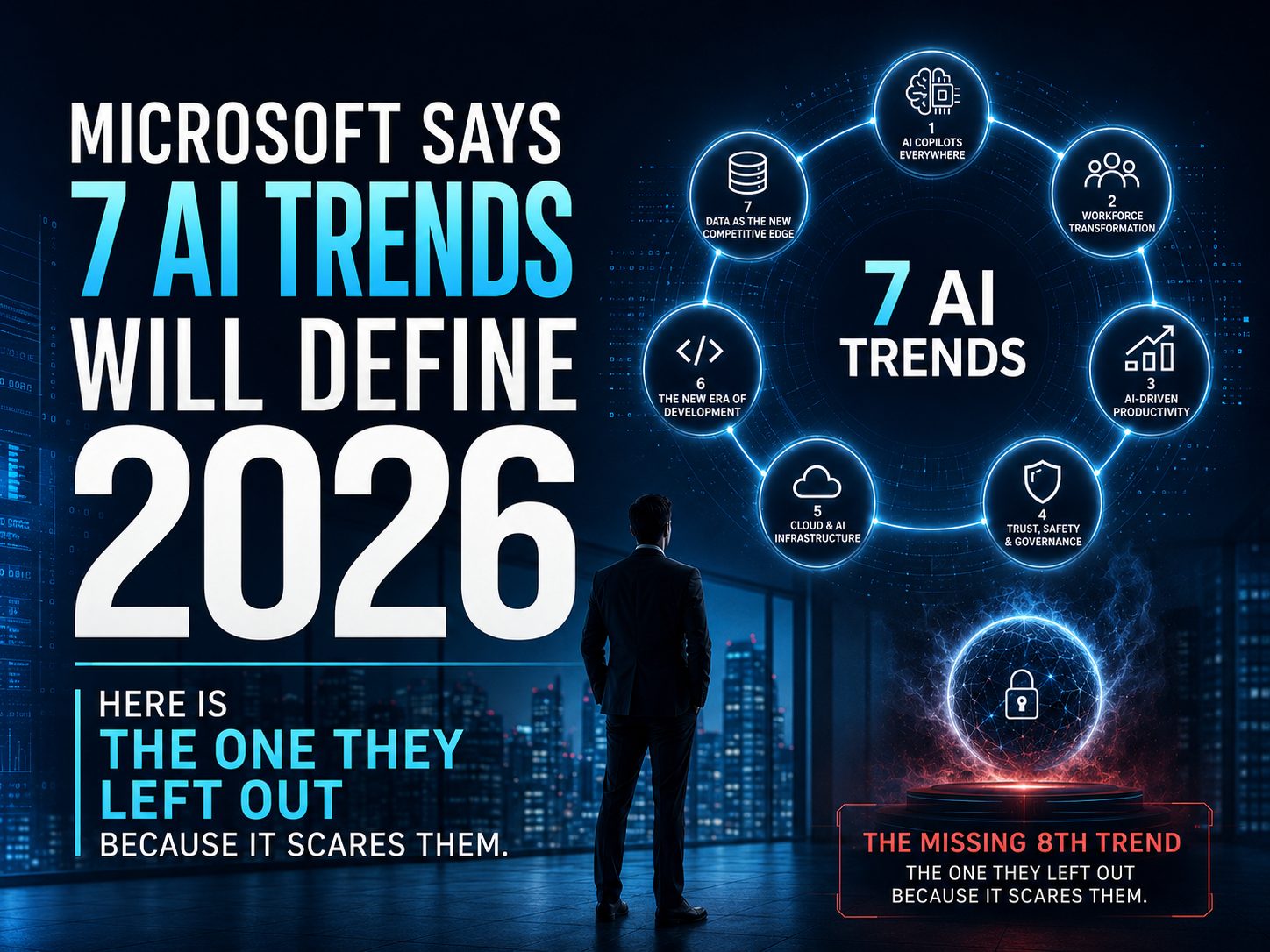
Microsoft Says 7 AI Trends Will Define 2026. Here’s the One They Left Out Because It Scares Them.
2026-06-22 · Engineering · 9 min read · @TechScribeWire
Their forecast lists everything AI will do for you next year. It’s silent on what AI does to the one resource that makes any of it work: your attention.
Microsoft published its forecast for 2026 back in December. Seven trends, one clean story: AI stops being a tool and becomes a partner.
It’s a good document. Well-built, well-sourced, full of named executives saying confident things. I read it twice.
The first time, I read it the way you’re supposed to — as a map of where the technology is going. The second time, I read it for what wasn’t on the page. That second reading is what this essay is about, because the gap turned out to be more interesting than anything in the seven trends themselves.
Let me give Microsoft a fair hearing first. They earned that much.
What Microsoft actually said The headline claim is that AI moves from instrument to partner. Aparna Chennapragada, their chief product officer for AI experiences, frames the whole year around a line that’s already doing the rounds: the future isn’t about replacing humans; it’s about amplifying them. She paints a picture of a three-person team launching a global campaign in days while the AI handles the data, the content, and the personalisation.
From there the trends fan out:
AI agents become coworkers, and Microsoft Security argues every agent should get the same protections a human employee gets so they don’t become “double agents” carrying hidden risk.
AI starts closing the global health gap. Microsoft’s Diagnostic Orchestrator hit 85.5% accuracy on complex cases, against a 20% average for experienced doctors, and Copilot and Bing already field more than 50 million health questions a day.
AI joins the research process — not just summarising papers, but generating hypotheses and running parts of experiments.
The infrastructure gets denser and more efficient. Think air traffic control for compute, so no chip ever sits idle.
Code gets “repository intelligence", where the model understands the history and relationships behind the code, not just the lines.
And quantum moves into a “years, not decades” window, with Majorana 1 as the proof of progress.
Read it as a slide deck, and it’s genuinely impressive. Read it as a worldview, and something is missing.
Every single trend is about capability. What the machine can now do. Not one is about the human on the other side of it.
The word that’s everywhere and the word that never shows up “Amplify” runs through the whole piece. Amplify expertise. Amplify teams. Amplify what people can achieve together.
Here’s the question Microsoft never asks: amplify through what?
Attention. That’s the channel. Every one of these “partnerships” runs through a human being who has to notice the AI’s output, weigh it, trust it or doubt it, and decide. The agent drafts. The human approves. The diagnostic engine suggests it. The doctor signs off. The research assistant proposes a hypothesis. The scientist decides whether it’s worth the lab time.
The entire value of “AI as partner” depends on a human still being awake at the wheel.
The one resource that makes all seven trends work — sustained human attention, the kind that can actually evaluate a confident machine — gets zero mention across the entire forecast. Not a sentence. Not a caveat.
I don’t think that’s an accident. I think it’s the one trend they can’t put on the list, because naming it would undercut the other six.
Why a company like Microsoft can’t say this part out loud This isn’t a conspiracy claim. It’s a structural one.
Microsoft sells the amplifier. The business model is more agents, more Copilot seats, more queries, and more compute. A forecast from Microsoft about AI is a forecast written by the company that profits when you lean on AI more, not less.
So of course the framing is “partner”. Of course the advice is "Don’t compete with AI; learn to work alongside it.” That advice isn’t wrong. But it quietly assumes the human stays sharp enough to be a real partner rather than a rubber stamp.
Ask the harder question and the deck gets uncomfortable fast. What happens to a doctor’s diagnostic judgement after two years of agreeing with an engine that’s right 85% of the time? What happens to a junior developer’s ability to read code after “repository intelligence” has been catching the errors for them since their first week? What happens to a scientist’s intuition when the hypotheses arrive pre-generated?
Look at the security trend specifically, because it’s the one place Microsoft almost says the quiet part. They argue every agent should get the same protections a human gets — a clear identity, limited access, monitoring — so it doesn’t become a “double agent.” Sensible. But notice the shape of the worry. They’re protecting the system from the agent. Nobody in the piece is protecting the human’s attention from the flood of agent output it now has to supervise.
Give a manager five agents and you haven’t removed five jobs. You’ve created a new one: the person who has to stay alert enough to catch when one of those five confidently does the wrong thing. That job is pure attention, all day, and it’s the most fatiguing kind — watching something that’s usually right, waiting for the time it isn’t. Microsoft secured the agent. It said nothing about the human now drowning in things to approve.
The honest version of the healthcare trend isn’t just “AI shrinks the health gap.” It’s “AI shrinks the health gap, and we will need to actively protect the clinician’s skill so the 14.5% of cases the machine gets wrong still get caught.”
Microsoft won’t write that second clause. Not because they’re villains. Because it isn’t their job, and it doesn’t sell Azure.
The attention cost is the hidden line item Here’s the part that should bother you if you run a team, a clinic, or a codebase.
Every one of these trends has a price that doesn’t appear in the forecast. Not a dollar price. An attention price.
When an agent drafts your campaign, you save the hours of writing. You also lose the slow thinking that used to happen while you wrote — the moments where you noticed the strategy was wrong halfway through the third paragraph. That thinking didn’t move to the AI. It just stopped happening.
When the diagnostic engine is right most of the time, “check the AI” turns into “trust the AI” within months. Vigilance is expensive, and the brain economises. The 85% accuracy isn’t the risk. The risk is what your attention does in response to 85% accuracy.
When repository intelligence catches the routine bugs, the developer stops building the mental model that used to catch them. The skill doesn’t transfer to the tool. It atrophies in the person.
None of this is an argument against the tools. I use them. They’re genuinely good. The argument is narrower and harder to dodge: the cost lands somewhere specific — on human attention and human judgement — and Microsoft’s seven trends route around that cost entirely.
A forecast that lists every benefit and none of the attention costs isn’t a forecast. It’s a brochure.
What the cost looks like at the team level Strip it out of the abstract for a second. Picture a small team in 2026 doing exactly what Chennapragada describes – three people, AI handling the grunt work, humans steering.
Week one, it feels like a superpower. The drafts are fast. The data’s pre-crunched. Everyone’s shipping.
Month three is where it gets interesting. The drafts are still fast, but nobody’s reading them as closely because they’ve been fine so far. The “steering” Microsoft promised has quietly become “approving”. The humans are still on the org chart. They’re just not really in the decisions anymore — they’re nodding at decisions the system already made.
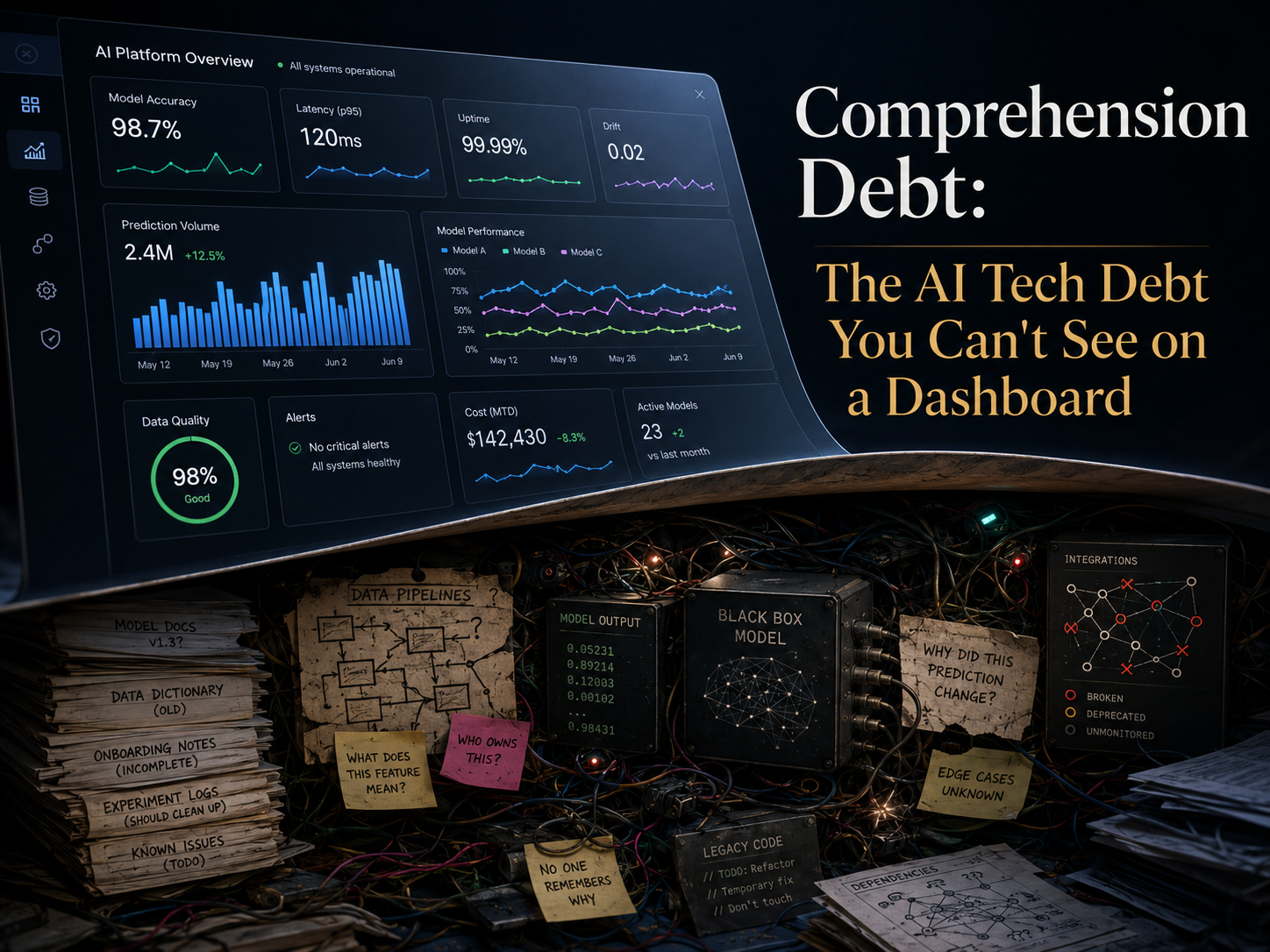
That’s not a failure of the tool. The tool did its job. It’s a failure of attention, and it’s invisible on any dashboard, because the output still looks good right up until the day it doesn’t. A team can run a long time on autopilot before the gap between “we approved this” and “we understood this” shows up as a real mistake.
The teams that win in 2026 won’t be the ones with the most agents. They’ll be the ones who deliberately keep a human sharp enough to overrule them — and who treat that sharpness as a cost worth paying for, not a tax to automate away.
“Trust is the currency of innovation” — and that line gives the game away Microsoft Security used a phrase in the piece that I keep coming back to: trust is the currency of innovation.
They meant it narrowly — trust that an agent won’t leak your data or go rogue. Fair. But pull the line out of its lane, and it’s the most honest thing in the whole document.
If trust is the currency, then attention is the central bank. You cannot trust a system you’ve stopped paying attention to. You can only defer to it. And deference dressed up as trust is exactly how good people sign off on bad outputs.
The 2026 that those seven trends describe is one where we’re asked to extend trust to more agents, more diagnostics, and more generated code, faster than ever. The thing that’s supposed to back that trust — our capacity to actually check the work — is the one resource nobody’s defending. It’s not on the list of seven. It’s not on anyone’s roadmap. There’s no Copilot for staying sceptical.
That’s the trend they left out. Not a technology. A liability.
The obvious objection, and why it doesn’t hold Someone will read this and say, ‘Every new technology gets this complaint.’ Calculators were going to rot our arithmetic. GPS was going to kill our sense of direction. We adapted. We’re fine. The skill just moves up a level.
It’s a fair objection, and it’s half right. We did adapt to calculators. Most of us also genuinely cannot do long division anymore, and we decided that was an acceptable trade because the stakes were low. Nobody dies because you reached for the calculator.
The difference in 2026 is the stakes and the surface area. We’re not outsourcing arithmetic. We’re outsourcing judgement – in medicine, in code that ships to millions, and in research that sets the direction of a field. And we’re doing it across so many decisions at once that the “move up a level” story breaks down. There’s no higher level to move to when the thing you’ve delegated is the act of paying attention itself.
Calculators didn’t ask you to trust them while quietly eroding your ability to check them. These systems do both at the same time. That’s the new part, and “we’ve always adapted” doesn’t cover it.
I’m not telling you to distrust Microsoft’s forecast. Most of it will probably come true. Agents will spread. Quantum will inch forward. The health numbers will get better.
I’m telling you to read it with the missing column drawn back in.
When a vendor — any vendor, not just Microsoft — shows you a roadmap of what AI will do for you, ask the question their business model can’t afford to ask. What does this do to the human in the loop? Where does the attention go? What skill quietly stops being practised? Who’s still awake enough to catch the 15% the machine gets wrong?
That’s not anti-AI. That’s the only version of “human in the loop” that means anything.
A human who’s stopped paying attention isn’t in the loop. They’re decoration on it.
Microsoft gave you seven trends about the machine. The eighth one is about you, and it’s the one that decides whether the other seven help you or hollow you out.
They didn’t leave it off because they missed it. They left it off because, written down plainly, it complicates everything they’re selling.